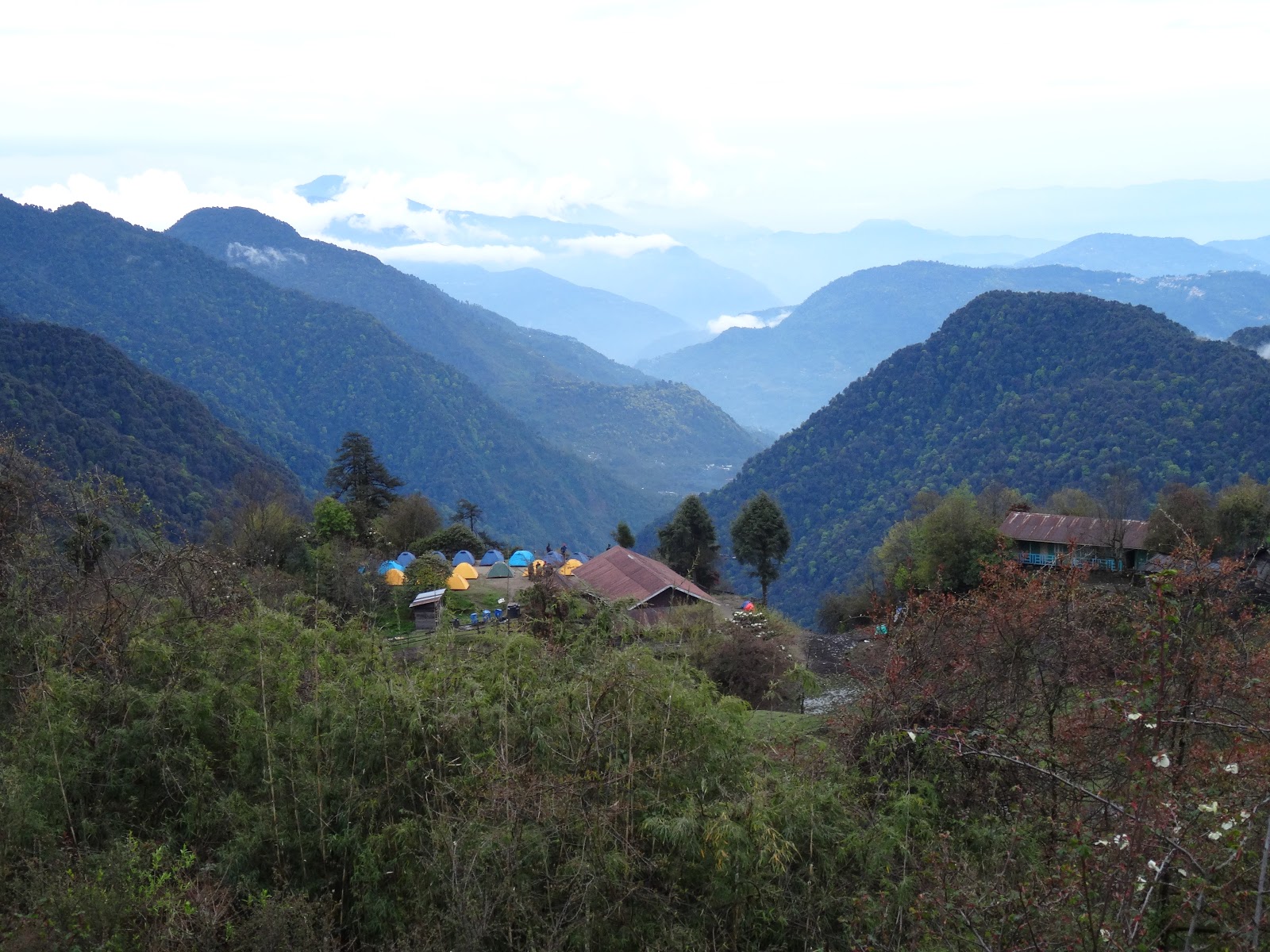
|
| Fields of Turutse |
Background
The Sham Valley trek is considered a "baby trek" and recommended as a first trek for acclimatization for visitors to Ladakh who intend to attempt treks over high passes. Two days after I flew into Leh, I decided to do this trek in preparation for a later trek in Markha Valley. The plan was to do the trek alone, but as it turned out I had at least one companion all along the way.
 |
| Purab's house |
Day 1 Leh to Tarutse
The 4 pm bus to Likir from Leh is jampacked. Since I had boarded the bus way before its departure time, I had a seat. In the bus I befriend an Israeli who is also headed for Likir. We reach Tarutse at 6.30. It turns out by a happy coincidence that the daughter of a homestay owner is also on the bus. Purab Dorje, a tenth class student, guides us to her home. We have ceremonial tea with the Bhutia family on the low seating with a bowl of Apricots placed in front of us.
Purab we find out studies in Leh and stays in a hostel. She knows Bhote, Hindi and English. Her father is a carpenter. She is the eldest of 3 siblings.
 |
| Purab with her grandmother and nieces |
There is a long evening ahead of us and Purab volunteers to take us to her uncle's house which is close to the Likir monastery. We get a great welcome in the house where several generations - Purab's grandparents, aunts and uncle and nieces and nephews - are living together. Purab's uncle is a soldier and her aunt teaches in Leh. Two other uncles are Lamas by choice. It is still light and we get a chance to see a watermill which is used to grind roasted barley.
Back at the homestay, dinner consists of butter tea and sattu followed by a stew of wheat momos, vegetables and milk served on the characteristic low tables and shared with family. I share the bedroom with Uri and a Frenchman who has been laid up by diarrhea.
(The homestay in Tarutse is run by Kunzang Dolma, phone 9469448973)
 |
| Likir Gompa |
Day 2: Tarutse to Sumdo
We begin the day with an intended quick visit to the Likir Gompa losing the way midway. Uzi has a running stomach and is desperate for his toilet paper. The return path is along the Likir
topko (stream).
After lunch we start the days trek heading for Yangthang. There are now three of us with the Frenchman Pierre joining us. Uzi is getting sicker by the minute and slows us down. After passing the Likir school, the path follows a line of electric poles. The tar road winds nearby. We reach the top of the pass (Phobe La 3580 m) from where the road winds down to Sumdo. There is also a footpath descending into the valley, but looking at Uzi's condition, we decide to follow the tar road. Climbing a mound just to the left of the road, we can see Sasopol
topko (stream) flowing down to Alchi. Further down the road we reach an intersection. One arm winds down while the other follows the topko upstream. The two houses that comprise Sumdo are just across the stream accessed by a rickety footbridge. The path beyond the footbridge disappears in brambles and we are not clear how to approach the houses. Just then, a man appears out of nowhere and after some negotiation we have a place to stay the night. One of the houses belongs to this farmer, while the other belongs to his sister who is a nurse and works in Leh.

Our rest is rudely interrupted by our host asking for help in his fields. Barley has been cut and stacked in the field awaiting the arrival of the thresher. Meanwhile dark clouds have gathered overhead and his crop is likely to get sodden unless protected. There is a massive tarpaulin sheet which the three of us help to move and cover the cut stalks. There are cut stalks with some grain strewn all over the field and the next task is the collect it with the family.
The women in the family, our hosts daughter, daughter-in-law and wife, are also busy in the fields. This means we have a late dinner. Over dinner we lean of this farmers travails. He has a back and tooth problem. Not many trekkers stop bye in Sumdo so he does not get much of an income. He is the only man here. His two sons are respectively in the army and studying in Chandigarh and he has no one to help him.
 |
| The pass |
Day 3: Sumdo to Hemis Shukpachan
Our host pleads with us to stay another day to help him in the fields and Pierre nearly accepts. We ask him to put Uzi in the bus for Leh that passes by later and start our trek.
The trail goes behind the farm in the upstream direction. We climb up to the top of the pass from where we can see the tar road leading to Yumthang. The road passes by a camping site where we rest a while. The trail to Hemis starts from near the camp and leads down to the river flowing far below.
We sit by the edge of the beautiful river for some time. The climb starts beyond the river. At the top of the pass, we see the tar road and Hemis comes into view.
 |
| Approaching Hemis |
Hemis is a large village, much larger than the others wwe have passed through so far. We spend a couple of hours trying to locate a homestay that has been recommended to us and it turns out that it is full. We settle for a guest house on the main street of Hemis.
Day 4: Hemis to Timosgang
This morning, we take the trail to Ang past the famous Juniper trees of Hemis. A large french group is travelling our way and we take help from their guides for direction. We enter a large plateau .... then veering right, we go down a gully till we enter a valley with a forbidding wall. The narrow trail zig zags up this wall to reach Mebtak La (3750 m).
The climb along the narrow zig zag path is scary. The steep incline of the mountain face means that a slip may result in an unstoppable slide down to the base. After the pass, the trail slopes down a gully and follows a straight line to Ang.
 |
| Timosgang |
Ang is not very impressive and we decide to press on towards Timosgang, a prosperous village with numerous Apricot trees and find a cosy guest house for the night.
That afternoon I have my fill of delicious Apricots, offered by the host family which is engaged in plucking them from a huge tree in front of their house. I wander around the roof of the house where apricots are being sun dried and help myself to more.
Day 5: Timosgang - Lamayuru - Leh
This morning, I bid adieu to Pierre. This is the end of our trekking trail and from here onwards it will be road travel. I am at the main intersection of Temisgang at 8am. It is some time before I get a lift to Khalse driving along the muddy brown waters of the Indus. I reach Khalse which looks like a military town at 9.30. At 10.15, I get a car to Lamayuru. We leave the Indus at the Batalik fork.
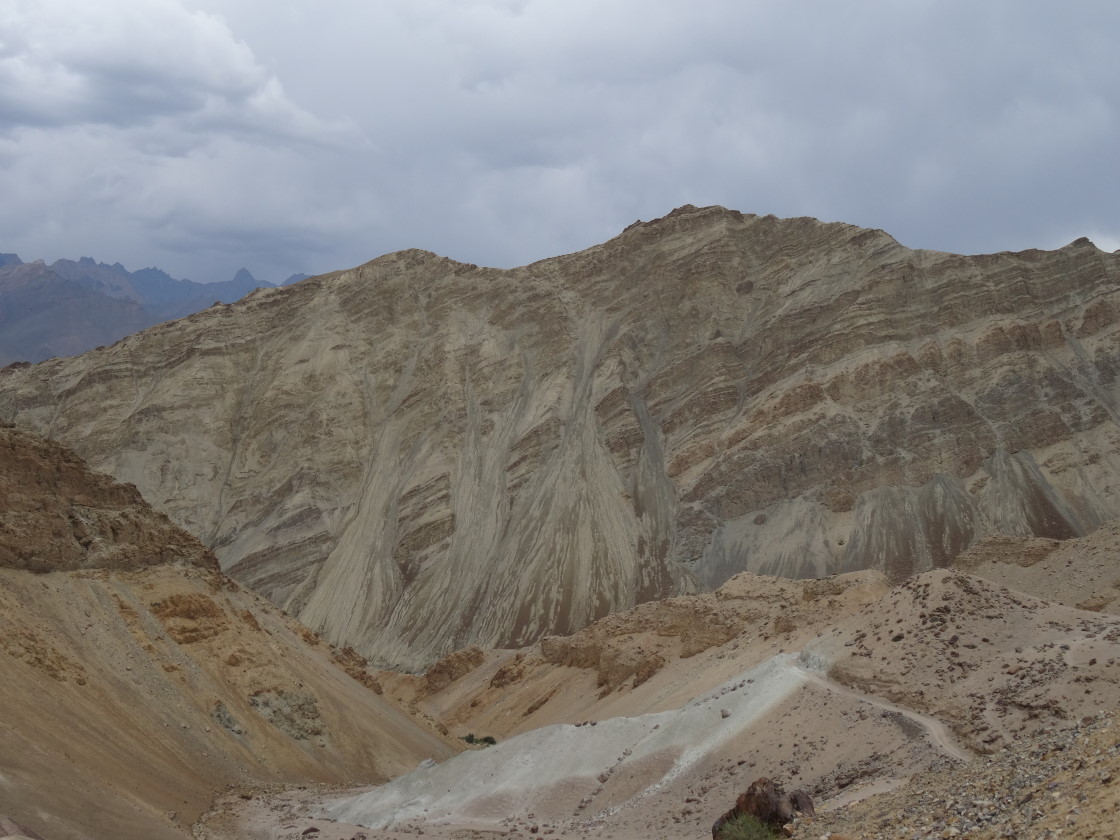
At Lamayuru, I bump into Pierre again in the company of a French couple who are travelling by car. I spend some time in the Gompa and also get a birds eye view of the "moon scape" of Lamayuru.
 |
| The "moon scape" of Lamayuru |
Getting back to Leh proves to be tougher than expected. There are no buses. After a long wait, I get a lift to Khalse.
 |
| Pierre and Uzi |
Then follows a hair-raising journey with a Lama in a maruti 800 to Leh. After a close brush with a car with some Punjabi youth, Lama Dorje chases the offending car and forces it to pull up by the side of the road. It is a wonder that there is no violence when Dorje gives the youth a piece of his mind. Emerging unscathed from the encounter, the Lama drives like mad and drops me right in front of my guest house.
Postscript:
I met Uzi again in Leh a few days later. He had recovered fully and was trying a motorbike on which he planned to ride to Timosgang.
Himalayan Trek 8, Aug 2013