Wednesday, February 5, 2014

On a pilgrim trail


Our trek starts at Lohajung, a small town in the Chamoli district of Uttarakhand, north of Almora and Kausani. For much of the next week, we will walk the trail of the Nanda Devi Raj Jat Yatra. The yatra organized once in 12 years symbolizes, for the faithful, the return of devi Nanda to Kailash after her visit to her mait (maternal home). The yatra takes pilgrims right up to the base of the Trisul massif at the edge of the Nanda Devi sanctuary. This ancient trail has been ‘rediscovered’ by trekking enthusiasts.

The path we take descends to a valley floor past terraced hillsides and patches of forest. The fields, their shapes dictated by the contours of the land, display crops of wheat, maize and potatoes. Horses graze in separate pastures. 

Ali Bugyal
Trim houses - made of stone and often double storied, with wooden windows and doors and slate roofs – stand scattered about. Narrow concrete channels lead down the hill slopes to water storage tanks in the fields. On a bright summer morning it is a pretty country. Reaching the floor of the valley, we cross a stream and climb up to halt at the village of Didina.

The next day, we start on a climb through a forest of Oak and Rhododendron to get to the bugyals - grassy meadows above the tree line - located above Didina. Deep inside the forest, I come across a group of young girls wearing colourful clothes, earrings and nose studs, and with sacks slung around their shoulders accompanied by an older woman. They greet me with a polite namaste and are not shy to talk but firmly refuse to be photographed. They have come to collect jhoola (lichen) in the forest. I later learn that the lichens from this area are procured by pharmaceutical and perfume industry and even exported.

Ali Bugyal

We emerge from the tree line on a grassy mountain slope with brilliant blue sky for a backdrop. I climb up to the ridge for a 360 degree view. The incredibly beautiful expanse of Ali bugyal unfolds to the north, stretching as far as the eye can see, its surface lovingly sculpted by the elements. 

Nanda Ghunti seen from near Bedni Bugyal
 In the distance, shiny black buffaloes make their way in single file over the pale green tinted silver grass, with no herder in sight. We have a long exhilarating walk over the length of the bugyal with grand views of mountain, cloud and sky.

The next day, the early morning sun lights up the great Himalayan snow peaks in full view of our camp at Bedni Kund. I recognize the fortress like Chaukhamba massif, the unmistakable pyramid shape of Neelkant standing sentinel over Badrinath and the pretty Nanda Ghunti (the veil of Nanda) standing so close. But most dramatic of all is the view from the trail of the knife edge ridge of Trisul rising majestically in waves to the pinnacle over 7000 m high.


The trail now is a paved stone path, visible over great distances. During the yatra, an endless line of pilgrims in colourful raincoats, and carrying staves, umbrellas and kitbags would be making its way over it. Now, it appears as a thin tear on the green paint of the hills. Below us, a huge flock of white sheep in perfect V formation moves over a bugyal. The shaggy sheep dogs wear metal collars with jagged edges; the danger from the baag (leopard) is real.

 We camp at the Pather Nachauniya (dancing stones) campsite. The graphic names of places along this trail are all part of the folklore of the Nanda Devi yatra. A fierce storm that evening that nearly blows away our tents serves to remind us of the violence that nature is capable of here in the lap of the Himalayas.

Trishul looming over the trail

The trail onward ascends a cliff, at the top of which is a little shrine dedicated to Ganesh with a black idol, appropriately named Kalu Vinayak. We have left the bugyals behind. The landscape is now bleak and the hillsides are covered with loose stones and streaked with snow.Dark clouds have descended to hide the mountain tops. Our next campsite, Baguwa Basa is set in these chilling surroundings.


We start walking at the crack of dawn. The trail climbs a mountain face, crossing several steeply angled snow fields. The hard and crunchy snow must be negotiated very carefully a step at a time; a slip will mean an uncontrolled slide down a slope whose bottom we cannot see. After a tense climb we reach the edge of a large crater set against a jagged wall of rock rising into the sun. The crater bottom, now partly in shade, is translucent ice with a sprinkling of snow. We have reached the famous Roopkund, a spot on every Himalayan trekker’s wish-list.
I climb a snow covered slope beside the crater halfway to the ridge line. Trisul rises over two km above where I stand, appearing as an inverted cone of rock and snow from this angle.


Trishul from Roopkund
During the yatra, pilgrims, many barefoot, climb the ridge to descend on the far side at the foot of Trisul. But this is as far as I will go. The return journey is already weighing on my mind; the snow on the slopes would have started to melt making the path slippery. I reach camp at Bedni Kund late afternoon, exhausted and feverish.

The walk down from Bedni is a relaxed affair. I get talking to Raju, a tailor from Lohajung, who has been ferrying our supplies on his khacchars (mules). He has lovingly named them Bunty and Babli, names to which they respond. They have large bells and colourful collars around their necks. They are loyal and can find their own way on the trails, he tells me with obvious pride.

At a clearing, we come across a man resting taking in the grand view; a backpack lies beside him with a small solar panel and an umbrella trussed to it. Umrao Singh has been camping in the higher reaches of the bugyals for several days collecting keeda jadi, a kind of caterpillar killed and mummified by a fungal infection. The jadi is prized in China as an aphrodisiac and for its use in Chinese and Tibetan traditional medicine and somehow finds its way across borders. Umrao shows me one keeda from the precious handful he has collected. That one alone could be worth a couple of hundred rupees!

Our last halt before the trek ends at Vaan village is at the small temple of Latu devta set under a beautiful clump of Deodhar trees. Latu devta, in folklore, is the adopted brother of Nanda devi. The great yatra stops here on its way up so that Latu can escort Nanda to Kailash.


This is my second travel piece published by EPW 

Tuesday, December 10, 2013

Diary of a trip to Tirthan and Seraj Valleys - Sept 2012


19th Sept: Aut -> Gushaini


Raju's guest house
We drive on the Mandi - Kulu road with the Beas on our left. I sit next to Pastor Thomas of Kerala who has his congregation in Kulu! There are vertical cliffs on either side - the Beas passes through a gorge here.The mountains are green after the monsoon ... we pass several waterfalls. It is a beautiful road and the driver plays old Hindi melodies.

We reach Aut at 9 am and this is where I get down. I find the bus for Rampur standing a little ahead. It is crowded. Starts at 9.30. We reach  Banjar at 10.50 am. There is a 11am bus to Bathahad. I get off in front of Raju's guest house a little before Gushaini village at 12.


The guest house is in an orchard next to the fast flowing Tirthan river, a tributary of the Beas. The sound of the river can be constantly heard. The Orchard has Alu (peach) and Japanese Persemon fruit (bright yellow fruit, the size of a large peach). We are served an excellent buffet lunch. Three dogs and three playful kittens co-exist in the farmhouse. 

The rainy morning has given way to a bright afternoon sun. Butterflies abound. I spot yellow billed Blue Magpie. The leaves of the fruit trees rustle in the breeze and reflect the brilliant sun. This is certainly a place to have an extended holiday with family. That evening, a campfire is lit up and I have a nice time with a group of birders from Chennai and a father - son couple from Delhi. We are served an excellent dinner that includes trout from the river.

20th Sept: Gushaini -> GHNP -> Gushaini


Ropa Village
I wake up at 6am and make tea. It is a cloudless day with blue sky. After a breakfast of Alu paratha, omlet, toast and coffee, I am ready by 8 am for the trek to the Great Himalayan National Part entrance gate.

At 9 am, I reach Ropa village walking on the left bank of the Tirthan. The jeep road gives way to a narrow path. At 9.30, two forest guards overtake me - they are heading for duty in the park that is still 6 km away. I reach the GNHP gate (Elevation 1920 m) at 11. Entry is not permitted and permits have to be obtained at a forest department office located elsewhere. I am now at the level of the Tirthan.


Tirthan Valley
I covered he last 2 km at a fast pace in the company of a work gang of carpenters from Tinder village working on a forest department contract to build a hut. But for them, it would have been difficult to find the path which has been sparsely used during the monsoons and is hard to find.

I start on the return journey at 11.30am. There is a gorge at the entrance to the park and a waterfall. A 1/2 km from the gate, the path has become a minor stream due to the incessant rainfall of the last few days. I reach a log hut at 12.30 and stop for lunch. There is some company here. When I resume the journey at 1pm, I am accompanied by a linesman. Reach guest house by 3 pm.


School children at Kothi Village


21st Sept: Gushaini -> Sai Ropa -> Jibi Road -> Ghyagi

Today, Raju's son Varun accompanies me. We catch a bus outside the guest house at 8.30 and get off at Sai Ropa complex 20 mins later.

We take a trail that climbs through the pine forest from near the Sai Ropa entrance. We pass through Kothi Village, then Vihar Village (1915 m) at 11:53am. Reach the magnificent tower - the Chehni Kothi with the Bahumati Jogini temple (2095 m) - of Chehni Village at 12.45 pm. The kothi is believed to be 1500 years old and is made of wood and stone. The impressive building opposite the temple is the bhandar for storing offerings made to the temple.


Kothi with Bhagwati Jogini temple, Chehni


Chehni residents


View during the descent from Channi


Descending from the village, we pass the beautiful Shringarishi Mandir at Baghi Village. The path leads down through a majestic line of Deodhars. I take snaps of Village Vihar and also of Banjar down below. We reach the main road ( Banjar - Jibi) at 3.30pm where I bid Varun goodbye. I take a bus (45min) to Ghyagi and take up a room at Shringi Vatika which belongs to the Gur (Shaman) of Shringa Rishi temple.

22nd Sept: Ghyagi -> Jibi -> Bahu -> Gada Gushaini

Next morning, I leave Ghyagi at 8.40 am and start walking towards Jibi. Reach Jibi (1760 m) at 9.15. The bus is expected only after some time, so I start walking towards Gada Gushaini. Reach Bharti Dhar village at 10.00 am. Road winds upwards and I take short cuts through the forest of Pine and Deodhar. At 11:30, after getting lost in the forest, I retrace my path and get back to the road. Bahu village is still 5 km away and I have missed the morning bus. I find a shortcut to Bahu through Spruce forest. Reach Bahu (2220 m) at 12.30 am. Have a maggie/banana lunch and start walking again at 1.30 pm.


Gada Gussaini
I am walking in the company of a local villager when he stops a truck - it is about 3 pm and we are probably an hour's walk away from Gada Gushaini. We pile on into the back of the truck. It drops us at Gada Gushaini (2285 m) in 20 min after a bone shattering/jolting ride over an un-tarred gravel road during which my hands holding on to the truck cabin nearly get pulled apart from their sockets. We pass a car that appears to be stranded on the road and a young man waves to me, surprised at seeing me standing in the truck.


I head for the PWD guest house which occupies the best location in the town, in the midst of a green carpeted field. The chowkidar readily agrees to give me a room. After settling the room, I persuade him to make  a simple dinner. He takes me on a walk through the market place. It is a typical small town but set in a beautiful valley with a stream flowing through. We buy some vegetables, rice and dal and I also pick up some food for the trek I propose to do the next morning. I also buy some liquor to share with the chowkidar. The chowkidar Roopchand also introduces me to one Roshanlal who does odd jobs and is in the middle of painting a store. Roshanlal agrees to walk with me to Jalori pass the next day.

My plans for a quiet evening with the chowkidar are spoilt with the arrival of two men - the same people who waved when I passed them on the road a while back. They are brothers, both wholesale merchants from Mandi who have come to buy the produce from local farmers. Their truck broke down on the way and that is how I happened to see them on the road here. They have come well prepared for the evening with a large bottle of whiskey and mutton of a mountain goat which they get the chowkidar to cook. Their stay here is settled by a call from a PWD engineer speaking on their behalf.

View from heights above Alwa village
Hill with Raghupur Garh on top
The traders get drunk and become boisterous. I am forced to spend the evening in their company. They boast about their power and connections in Mandi and invite me to visit them but let out little about how the trade works despite my prying. I ask them about FDI in retail but they don't seem to be very concerned about it. The truck driver and the mechanic who has been brought all the way from Mandi also share the dinner. The goat is tough as I am told, pahadi animals tend to be and I have a difficult time chewing it.


23rd Sept: Gada Gushaini -> Jalori Pass -> Ghyagi


Roshan Lal arrives on time - around 6 and we start on our trek. Reach Alwa village (2475 m) after a steep climb at 6.50am. At 7.50, I notice that we have reached 2700 m. I find out that this area produces Alu, Matter, Lasoon, Gobhi and some Apple. Roshan Lal himself is a farmer. At 8.30, we have reached a height of 2840 m and stop at a clearing for breakfast from where we can get a view of the Raghupur Fort across a valley. The ridge on which we are walking circles around to get to Raghupur Fort. Snow peaks can be seen to the North and North-East. To the South West is another fort, Madhupur Garh. At 10 am, we have reached 3040 m and are amidst Karsu (Oak) trees. 


The Kharsu forest
Walk is now through a Kharsu forest with views of the Greater Himalayn peaks of Lahaul, Rohtang Jot and peaks of Shrikhand Mahadev Range. We reach a saddle point above meadows - Kunala Thatch (3095 m) at 10.30 am - with views of the Shrikhand range . 

We descend to 3000 m and commence climb to the Fort. Next point is Pandavo ka Khet at Sukhsar (2965 m). The Fort appears on the hill top right behind the khet. The belief is that though the fields have paddy they never produce rice. The story goes like this: While the Pandavas were planting the rice one night, people of a nearby village woke up and the P's had to leave in a hurry, leaving the planting incomplete.


Meadows 
We reach the fort (3195 m) at 12.30. The grass is dotted with yellow flowers. We start the descent to Jalori just after 1 pm. Reach the road at Jalori pass (3045 m) at 1.45. After lunch, we have an interesting conversation with a local thanedar. He advises me to stay at the campsite near Jalori - I am somehow uncomfortable with this advice and decide to return to Ghyagi. It turns out to be a mistake. The policeman helps us to get a lift with the SP of Kulu who chances to come by. I am back in Gyaghi that evening.

24th Sept: Ghyagi -> Jalori -> Saryalsar -> Khanag -> Ani -> Sainj

8.30 am: The bus to Jalori (coming in from Banjar) is overcrowded. I manage to place my haversack on the roof and squeeze in. At Jalori, I have to climb up, untie my bag and get down with it in a couple of minutes - with the conductor rushing me. Start trek from Jalori at 10 am in the company of a couple from Israel. Reach Saryalsar lake (3080 m) at 11.45. Lake is somewhat disappointing, though it is a fine trek. The edges of the lake smell of ghee. I later find the explanation for this: Budhi Naagin, the goddess of ghee is worshiped here  and pilgrims walk around the lake pouring ghee in an unbroken line!
                              
Pandavon ka khet

Start walking again at 12.30 and descend to Khanag by 2.00, this time in the company of a local couple who have come to see the lake. Unable to find accommodation at Khanag PWD - engineer staying there says that   work is going on to remove a landslide on the way down from Jalori pass and rooms are reserved for people working there. It starts raining. I discover that there is no other accommodation in Khanag with toilet facility. That decides me and I catch a bus to Ani and then after seeing a dreary town, catch another bus to Sainj where I check into a hotel.
Saryolsar


25th Sept: Sainj -> Shimla -> Delhi

Catch a bus at 7am for Shimla. Then a 12.30 bus to Chandigarh. Am in Delhi that night.


Himalayan Trek 6, Sept 2012

Friday, November 8, 2013

The road to Kunzum La


My first travel piece in EPW. The full piece is available here. Photo's from the trip and a longer writeup from which this piece is extracted appear in my blog

Kunzum La - Aug 30 2013

Sunday, November 3, 2013

Birds in the Shivaliks of Himachal Pradesh

This diwali, I  moved to a guest house (picture on the right) in the lower Shivaliks to escape the noise and pollution of the metro and to spare our 10 year old lab a traumatic week. The guest house is located in the settlement of Nehli Dheeda which as far as we can see has only a couple of houses and a general store. Nehli Dheeda is on the Nahan - Jamta - Dadahu -Renuka road and is a little over 1000m height as deduced from Google terrain maps.

This Jamta - Dadahu stretch of the road has thick forest on either side with isolated farms and houses. The area is rich in birds. Here are some of the birds I managed to capture on camera.

Great Tit.

Along with the Himalayan Bulbul, this seems to be the most common species here.


Scaly-Brested Munia (right) and Juveniles (below)

Chestnut-Bellied Rock Thrush pair (male - left and female - below). The identification was made easy by the fact that I spotted the male and the female in the same area.

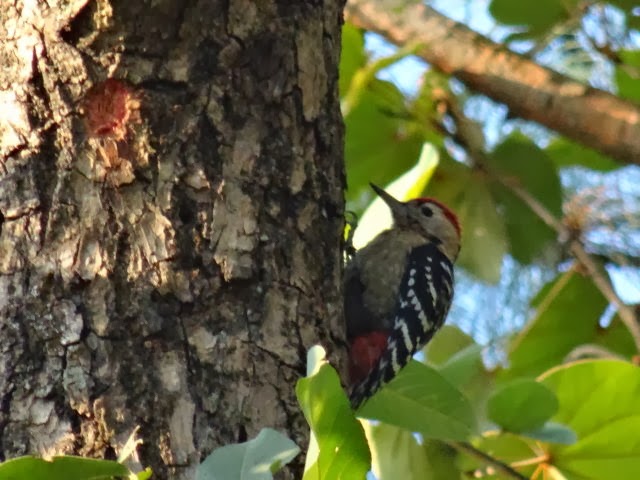
Fulvous-Breasted Woodpecker

Chestnut-Bellied Nuthatch

White Eye - this bird is also seen often


My third morning of bird watching also yielded good results. I spent almost the entire morning 7-9 am at one spot - roughly half way down to the river on the jeep track going down from Nehle Dheeda.

Bush Warbler (?)

Himalayan Bulbul

Long Tailed Minivet - female (right) and males (below)

Ashy Drongo

Minivet (female) ??

Grey Bushchat - male (right) and female (below)

White-Crested Laughingthrush

These move around in groups of 3 upwards. Forage noisily under the trees and foliage like Bablers. They indeed seem to laugh (shrill mocking sounds joined by all). Very noisy but very shy on becoming aware of humans!

Two members of a flock of Black Bulbuls that alighted on a tree just in front of me


The highlight of my fourth morning of bird watching here is a Scarlet Minivet that reveals itself unmistakably.

Grey Treepie

Grey-Capped Pygmy Woodpecker (male)

Bar Winged Flycatcher Shrike